
Dinner with a home cook
Local dishes cooked by a family in Tân Hóa, 200,000 VND (~US$8) per person. Book a day ahead.
Home cooks ↓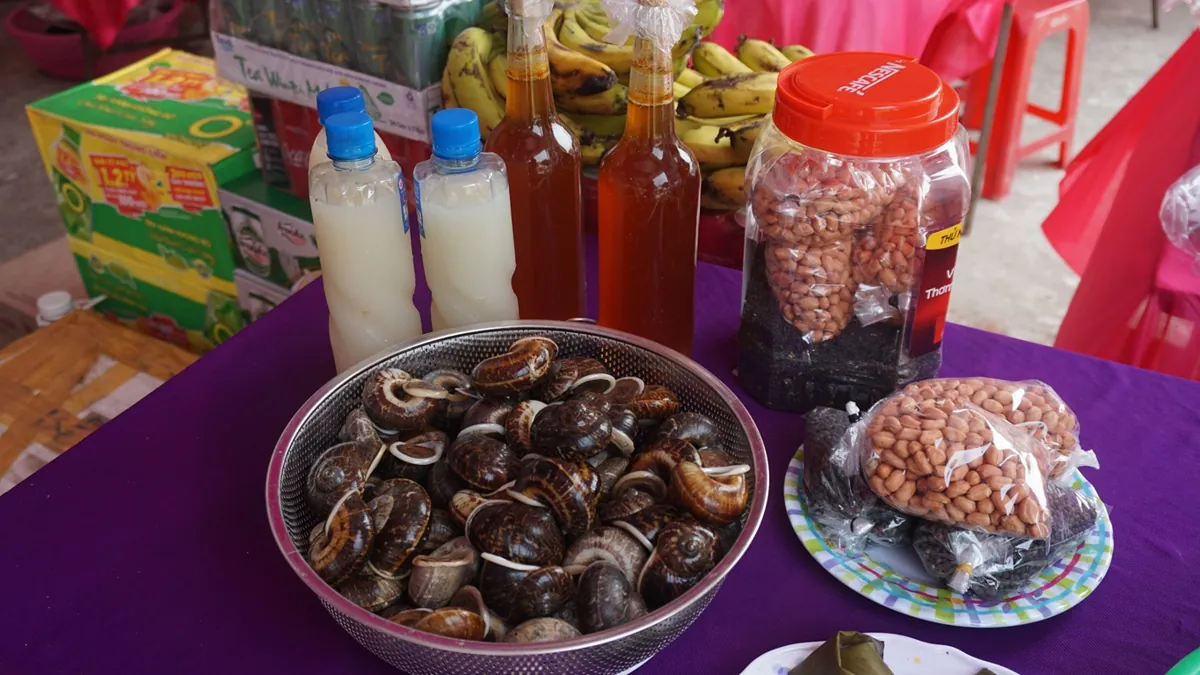
What to eat
There are limestone mountains everywhere and little paddy land, so a meal here is gathered from corn fields, streams, cliffs and forest nests. Kim Phú was part of the old Minh Hóa district, so Minh Hóa's specialties are its own. Most dishes are on no restaurant menu: book a home cook a day ahead, and for seasonal dishes your host will tell you what there is that day.
Local dishes cooked by a family in Tân Hóa, 200,000 VND (~US$8) per person. Book a day ahead.
Home cooks ↓Some homestays cook for their guests. Ask your host when you book.
Homestays →Roadside places on the Hồ Chí Minh Road, and the Tú Làn Lodge restaurant with a view over the Tân Hóa valley like nowhere else.
Restaurants ↓Dinner of local dishes in Tân Hóa, 200,000 VND (~US$8) per person. Book at least a day ahead; most cooks speak Vietnamese only, so message us on WhatsApp and we will arrange it.
Three on the Hồ Chí Minh Road, in the order you reach them from Phong Nha, then the Tú Làn Lodge restaurant in Tân Hóa village. For group bookings, message us on WhatsApp and we will arrange it.
Cơm bồi: corn soaked overnight, pounded before dawn, steamed under banana leaves. Rolled into balls, eaten by hand.
Read more ↓Snails from cracks in the limestone, out only after rain. Grilled, boiled or stir-fried, eaten with pồi.
Read more ↓Chickens, ducks and pigs here are still raised the traditional way, roaming the family yard and grown slowly. The meat is firm and full of flavour; many visitors are surprised how much better it tastes than elsewhere. Every family raises them and every eatery serves them; just let your host know in advance.
Sap from the top of a đoác palm with forest bark as a starter, ready in hours. Never distilled.
Read more ↓Hunted from March to May, when the ants nest in the trees. Ivory-white and rich: cooked in a sour soup with lá bún, stir-fried with lime leaves or steamed with sticky rice. First time? Start with a small taste.
Read more ↓Leaves of a wild plant from the stream banks, pickled before cooking. The aroma is unlike anything else, and once tasted it stays with you. Besides ant-egg soup, lá bún is stir-fried on its own or with stream snails.
Read more ↓Vò vẽ wasp pupae, harvested in full protective gear. Pan-roasted with lime leaf, stir-fried or in a salad.
Read more ↓With cơm bồi, the pairing Minh Hóa food is known for.
Grilled cá mát, a regular at the Full Moon market.
Silkworms fed on cassava leaves, pan-roasted. An unusual upland dish.
Also called rau dớn: young shoots of a wild fern from damp stream banks. Boiled, stir-fried with garlic or in a salad; crisp and slightly silky. Served at Cường Nhi and Ánh Tuyết on the Hồ Chí Minh Road.
A broth slow-cooked from bones and meat with the tender inner core of a banana stem, finely sliced. The banana core turns soft and sweet and soaks up the broth; best eaten hot on a rainy mountain day.
In limestone country there is little paddy land but plenty of corn and cassava on the hillsides. From them the Nguồn people make pồi, also called cơm bồi, their everyday staple in place of rice. The afternoon before, corn is soaked in boiling water and covered until the kernels swell. At dawn it is pounded into flour, sifted, spread thin on a small tray under fresh banana leaves, and steamed. Some families mix in pounded cassava.
Cooked pồi is light and soft, with a plain, earthy taste of corn. Its shape depends on each family’s steamer. At big meals, especially with several generations at the table, people roll pồi into small balls and pass them to one another as they talk.
Pồi is eaten with wild-greens soup cooked with stream fish, a plate of boiled snails, or simply dipped in salt pounded with chilli and wild lime leaf. At Minh Hóa’s Third Full Moon festival it is always the signature dish on sale. To understand a Nguồn meal in Tân Hóa, start with a handful of pồi.
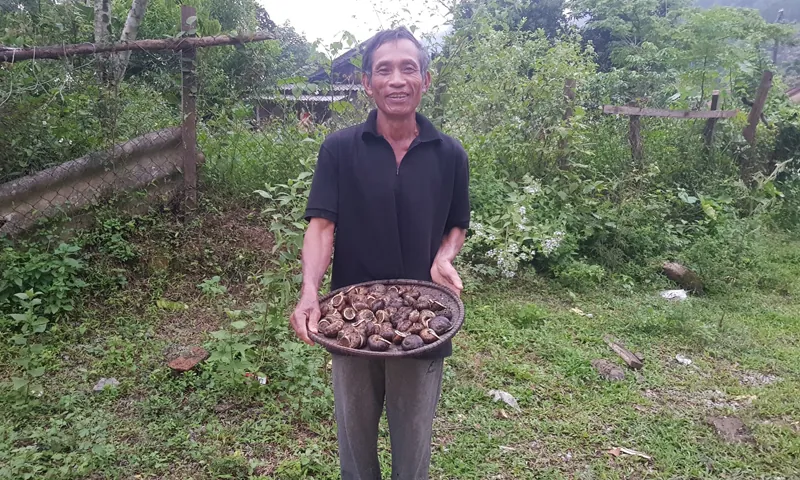
“Lèn” is the local word for the limestone peaks. Lèn snails live in the cracks and hollows of the rock around Kim Phú, with dark brown, banded shells. In dry weather they stay hidden; after rain they come out, and that is when villagers go to gather them.
For the Rục, rock snails have been forest food since their grandparents lived in the caves. Until recently some elders still gathered a few dozen around their rock shelter for each meal and roasted them in the embers; roasted snails also served as bait for mountain-rat snares.
In family kitchens they are grilled, boiled or stir-fried and eaten with pồi. A simple dish, and one that reminds you exactly where you are.
The đoác is a palm that grows on the limestone. The Rục cut into the top of the tree, catch the sap in a hollow in the rock, and drop in a piece of forest bark as a starter. In about two hours it already smells of wine. No pot, no fire, no still.
This is how the Rục made wine when they lived in the caves, and people who go into the forest can still make it on the spot. In the hamlet it is often poured for guests at a meal.
Because it depends on forest trees and on the few who know how, there is not always some to be had. If you are offered a cup, accept it; if you would rather not drink, just say so and no one will mind.
In season, villagers across the mountain communes of western Quảng Trị, Kim Phú among them, head into the forest to hunt ant eggs. With knives, machetes, sacks, basins, bamboo trays and kitchen ash, they find a nest, break it open and sift out the eggs, to sell and to cook for guests.
The classic dish is ant-egg soup. Around the old Minh Hóa district, now Kim Phú and its neighbours, the eggs are cooked with lá bún, the sour leaves of a wild plant that grows along stream banks. The soup is rich from the eggs and lightly sour from the leaves.
In season it is a regular on the table when mountain families host guests. For visitors it is probably Kim Phú’s most unusual dish, and the one many remember longest.
The mountains of western Quảng Trị have long kept bees and wasps: honeybees for honey, and the hornet-like vò vẽ wasp for its pupae. Vò vẽ are famously aggressive. Villagers bring nests in from the forest, hang them around their gardens, and when the nest is full they harvest it in full protective gear.
The pupae are ivory-white and rich. They are pan-roasted, stir-fried with lime leaves, or made into a salad; around Minh Hóa, wasp-pupae salad counts among the signature dishes of the uplands. They fetch a good price, several hundred thousand đồng a kilo, so families save them for honoured guests.